

POSTED April 1, 2026
6 Legendary Jazz Musicians
To honor Jazz Appreciation Month, we are spotlighting six towering jazz musicians and artists, celebrating the music that made them legends, and sharing how they came to be part of Alvin Ailey American Dance Theater’s repertory.
Since his very first work for the company, Alvin Ailey has been influenced by jazz and the blues, and over the course of his career he collaborated with and took inspiration from some of jazz's biggest legends. Today, we honor their trailblazing artistry.
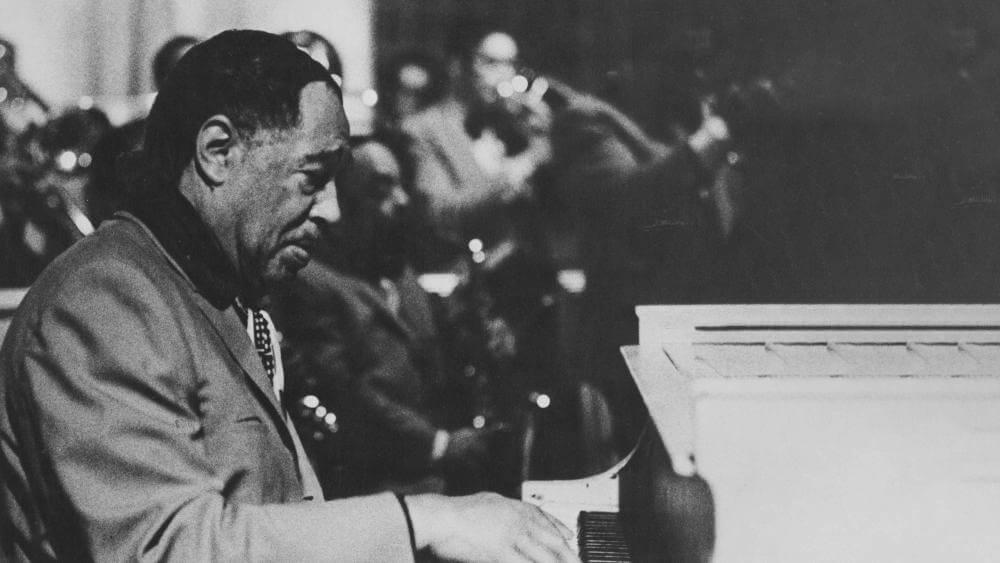
Duke Ellington
A pianist and composer of era-defining talent, Duke Ellington is considered one of the greatest jazz musicians, composers, and bandleaders of his generation. He put his hand to big-band, ragtime, jazz, opera, and symphonic music, leaving indelible marks on all of them in the process. His ensemble nurtured dozens of jazz musicians who would define the genre. After growing up in Washington, DC, he moved to New York, making a name for himself in the jazz clubs of Harlem. Mr. Ailey met Ellington in 1963 (although he’d watched him perform at clubs in Los Angeles years earlier), and Ellington was in the audience for Mr. Ailey’s first performance of Blues Suite. In 1970, Mr. Ailey choreographed The River, the first time Ellington composed a piece specifically for his choreography. He eventually used Ellington’s compositions for many of his ballets, including The Mooche, Pas de Duke, and Night Creature. “As giants go, Duke Ellington was one of the largest and grandest of them all,” Mr. Ailey wrote.


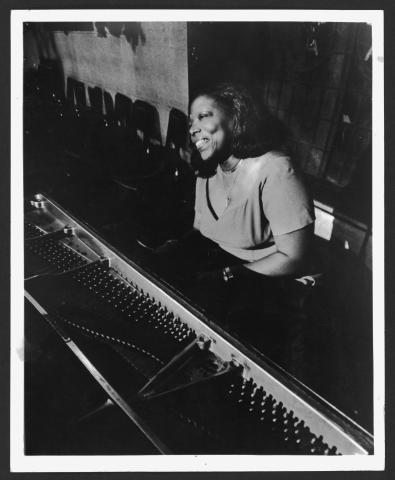
Mary Lou Williams
Mary Lou Williams was one of the most sought-after jazz and bebop musical arrangers of her generation. On the piano, she pioneered a style of improvisation and super speed that many others took as inspiration. “I try to write music that would give peace to the soul or the heart,” she said in a 1971 interview. Born in Atlanta, Georgia, in 1910 and moving to Pittsburgh, Pennsylvania, when she was four, she eventually wrote arrangements for the titans of jazz—Duke Ellington, Louis Armstrong, Benny Goodman—and became a mentor to bebop musicians including Thelonius Monk, Dizzy Gillespie, and Charlie Parker. Williams first dreamed of collaborating with Mr. Ailey in 1965 and in 1970, Mr. Ailey began work on a ballet entirely dedicated to Mary Lou Williams’ music titled Mary Lou’s Mass, what he later called “one of the great creative experiences of my life.” The work, danced to her “Music for Peace,” combined both Williams’ and Mr. Ailey’s deep affinity for blues, swing, and gospel music along with the culture of the Southern Black church. During the performances, Williams conducted the musicians and the dancers from the piano in the orchestra pit.


Charlie Parker
Nicknamed the “Bird,” Charlie Parker has been cited as the greatest saxophonist of all time, and one of the few jazz musicians who can claim to have changed the genre. Born in Kansas City, Kansas, he became a jazz legend in New York City, performing at clubs like Birdland (named after him) and becoming one of the originators of the evolution of jazz into bebop. His wild, freewheeling saxophone mirrored his unpredictable and chaotic life; he died at age 34 after years of substance abuse. Alvin Ailey choreographed For ‘Bird’ —With Love as a tribute to him for the company’s 25th anniversary, bringing the vibrant jazz club scene and the characters that populate it to life on stage. Mr. Ailey had saved boxes of research on Parker and the resulting work was originally 75 minutes long—a love letter to one of Mr. Ailey’s troubled idols.


Dizzy Gillespie
What Charlie Parker did for the saxophone, Dizzy Gillespie did for the trumpet. Born in South Carolina in 1917, Gillespie began playing trumpet when he was 14, and in Harlem he played with Teddy Hill’s and Cab Calloway’s bands. He took inspiration from Mario Bauza (who also played with Calloway), fusing the big-band swing with Bauza’s Afro-Cuban rhythms. Gillespie was also a friend of Charlie Parker and helped push jazz into bebop with his frenetic improvisational style—hence the nickname “Dizzy.” Alvin Ailey used Gillespie’s music in his ode to Parker, For ‘Bird’—With Love. Throughout the years, Gillespie’s music has also scored works by other Ailey choreographers, including Billy Wilson’s The Winter in Lisbon, Ronald K. Brown’s Serving Nia, Kyle Abraham’s Another Night, and Jamar Roberts’ A Jam Session for Troubling Times.


Count Basie
William “Count” Basie was not only a legendary jazz pianist and organist, but he was also one of the most famous bandleaders of the jazz age. His arrangements gave many legendary soloists their moment to shine, including Lester Young, Earl Warren, and Herschel Evans on saxophones; Buck Clayton and Sweets Edison on trumpets; and Benny Morton and Dicky Wells on trombones. He made his name in Kansas City with the best jazz bands in the city: Walter Page's Blue Devils and the Bennie Moten band. In New York, he played at the Roseland Ballroom and eventually had a residency at Birdland. As one of the jazz greats, Basie’s music has been used in numerous of the company’s ballets, from Mr. Ailey’s For ‘Bird’—With Love to Amy Hall Garner’s CENTURY .


Ella Fitzgerald
Ella Fitzgerald, the “First Lady of Song,” was the most prolific jazz vocalist of her lifetime, lending her instantly recognizable voice to every great jazz bandleader of her era. She grew up in Yonkers, New York, and was discovered during an amateur night at the Apollo Theater in Harlem. She then went on to front Chick Webb’s orchestra at the Savoy Ballroom. As her reputation grew, she recorded songs with Duke Ellington, Count Basie, Louis Armstrong, Cole Porter, and countless others. Her recordings became the high watermark for many jazz staples and originals, including “Take the ‘A’ Train,” “How High the Moon,” “A-Tisket A-Tasket,” “Cheek to Cheek,” and “Summertime.” She was also one of the finest practitioners of scatting, using her voice as an instrument of improvisation in play with her live accompaniment. While Alvin Ailey never choreographed to Fitzgerald’s music, she has been used in the works of other choreographers for the company, including Judith Jamison’s Reminiscin’, Camille A. Brown’s The Evolution of a Secured Feminine, and Robert Battle’s Ella, a direct tribute performed in anticipation of the singer’s centennial celebration.


Explore Our History
Discover more stories that helped shape Alvin Ailey American Dance Theater's trailblazing history.
Hero Credit: Photo by Jack Mitchell