
POSTED January 7, 2026
Revisiting Hermit Songs
In 1961, when Alvin Ailey choreographed the first iteration of Hermit Songs, he was at a turning point in his artistic career. Revelations had premiered a year earlier and catapulted him to national (and soon global) recognition.
Hermit Songs was the very next piece Mr. Ailey created, taking his exploration of his own spiritual upbringing to a more personal place. He sought new inspirations and references that were not always drawn from the African American cultural heritage, and returned to the solo form to explore his relationship to faith—moving from the celebration of community to the dark night of the soul.
For the company’s recent season, choreographer and former Ailey dancer Jamar Roberts chose to revisit the work as the starting point for his own premiere, Song of the Anchorite. “I've always been interested in excavating things from the past,” Roberts said. “Normally, I do it in the music that I use, but this is the first piece I've done for Ailey that has this amount of real historical context.”

In Hermit Songs, Mr. Ailey performed to six movements from Samuel Barber’s cycle of songs of the same name. Barber’s Hermit Songs, composed in 1953, drew from medieval manuscripts of Irish monks from the 8th to the 13th centuries. Like the spirituals at the heart of Revelations, the short songs express the doubt and fulfillment at the heart of faith, something that spoke to Mr. Ailey deeply. The recordings used for Mr. Ailey’s performances were sung by soprano Leontyne Price, the first African American opera singer to establish herself as a mainstay of the Metropolitan Opera.
The music revealed something deeper in Mr. Ailey’s ambitions. While he stated proudly that the intention of his company was to uplift Black artists, music, and dance forms, he also looked for inspiration in art and music from outside the Black experience, bringing his own creativity to bear on the world as freely as any other artist. Leontyne Price’s operatic vocals reflected that possibility; a Black artist fully inhabiting and exceeding in an art form that was not always welcoming to Black artists.
When Hermit Songs premiered in 1961, New York Times critic John Martin praised the work, writing, “Mr. Ailey is almost continuously in motion, and with a superb quality of movement that is unselfconsciously beautiful in itself and altogether eloquent.” After its debut, Mr. Ailey edited the work, cutting two songs. Future performances became a vehicle for many of the company’s most prolific men, including Kevin Rotardier, Clive Thompson, Dudley Williams, William Louther, Gary DeLoatch, and Andre Tyson. After a brief revival in 1990, during Judith Jamison’s first season as artistic director following Mr. Ailey’s death, the work had its final performance in 1991.
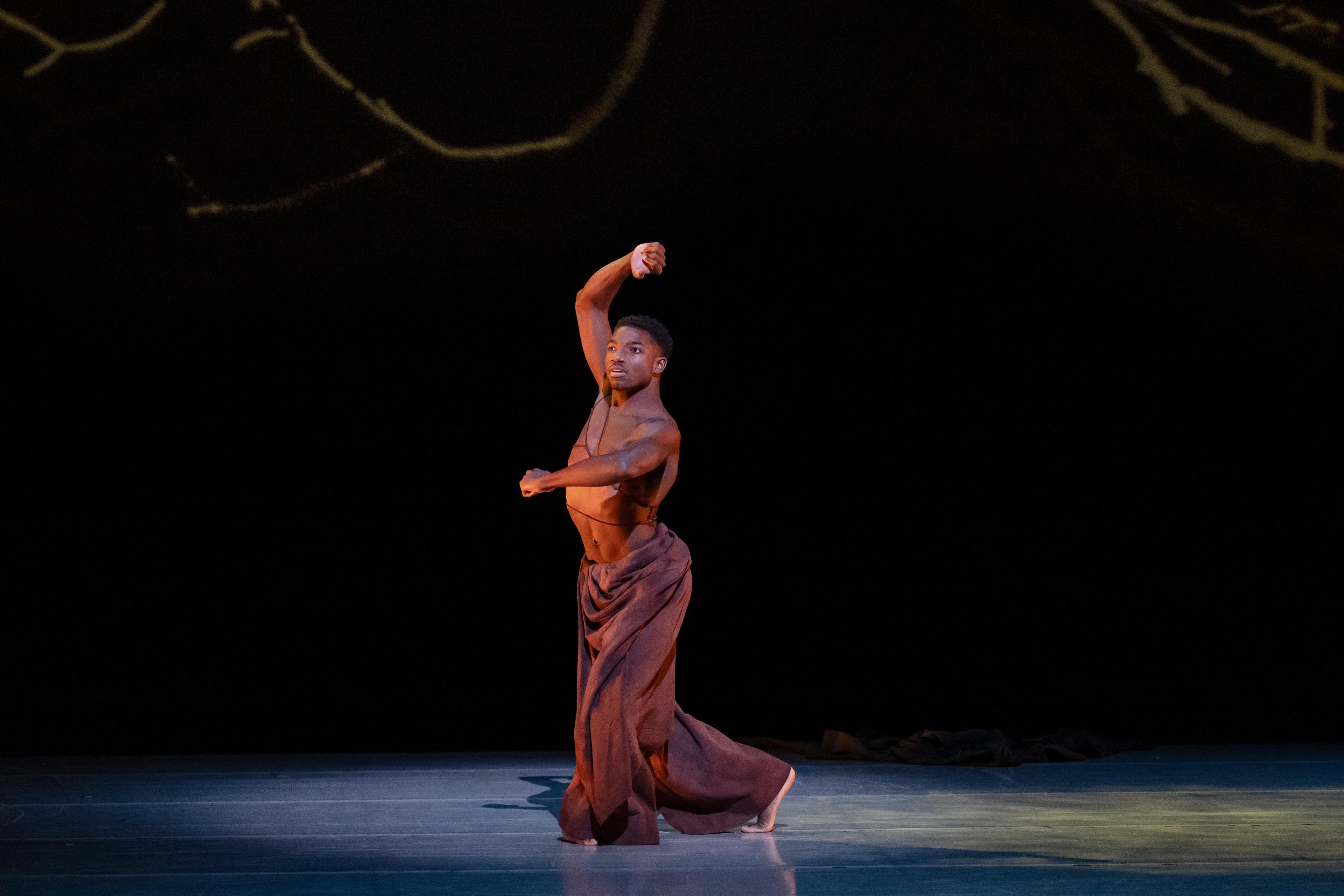
Roberts grew up in a Christian household, and in preparing to reimagine Hermit Songs, he reflected on his own relationship to and history with spirituality. He also researched monastic figures with roots in Christianity, such as the “desert fathers” who would isolate themselves in the desert to study the Bible, and the anchorites, who performed the same seclusion without the pilgrimage, remaining indoors. Attempting to get closer to understanding these figures, Roberts began to imagine, “what if this religious hermit could sing or express everything that they were feeling during their time in isolation?”
That solitary inner search for an authentic spiritual expression likely mirrors Mr. Ailey’s own impulse when he approached Hermit Songs. “Revelations feels to me a lot about the collective Black experience, and Hermit Songs to me feels very personal,” Roberts said. “In my experience, there's always this relationship to God, to the community, and then to self. So maybe Hermit Songs was something that was a little more personal for Alvin; something that he wanted to speak about in a religious context about himself, for himself.”
In preparation, Roberts watched rehearsal videos of Dudley Williams and Kevin Rotardier dancing Hermit Songs—he could hear Mr. Ailey’s voice offering directions to the dancers just off camera. However, Roberts wanted to give himself distance from the original material. “I don't want to make the solo verbatim,” he said. “Everything that Alvin had to teach me about his work and about his movement, I've learned. It was passed down to me from the elders. It's all in there, inside of my body. Whatever is going to be interpreted choreographically, I think Alvin's influence will come out, but my influence will be there as well.”
Even before Hermit Songs was retired from the company repertory in 1991, it was not performed very often. For the majority of audiences, Song of the Anchorite will be their first encounter with the work, something Roberts wants to honor. “I thought about the Ailey audiences who have never seen this piece before, and I thought that it was important to not stray too far away from the original, because then you don't really get the essence of Alvin,” he said. “When the audience watches Song of the Anchorite, I want them to feel like it's very familiar. Whether that be in movement or in sound or just the overall essence, I would love for it to feel like something of Alvin's that they've felt before.”

Ailey on Tour
Hero Credit: Photo by Alice Castro